
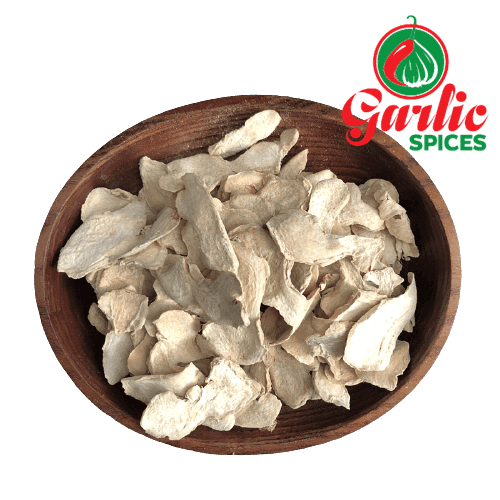
What Are Dehydrated Ginger Flakes?
Ginger flakes offer a cut form for seasoning blends, dry mixes and food processing. They suit buyers who need visible ginger pieces rather than powder. For bulk ginger flakes, send us your required specification, packaging preference, order quantity and destination.
Dehydrated Ginger flakes are a sliced form of whole ginger, then heat dried at 60 degrees for 6 hours and second dried at 75 degrees for 1.5-2 hours. It can be added into soups, stews, salads for its nutrition and dense natural pungent flavor.
Our dehydrated ginger products include
- dried whole ginger
- Dehydrated ginger flakes 4mm thickness
- Dehydrated ginger granules 4-8 mesh, 5-10 mesh, 8-16 mesh, 16-26 mesh, 16-40 mesh
- Dehydrated ginger powder 80-100 mesh
| Name | Dried Ginger Flakes |
| Appearance | Natural color and smell with ginger flavour |
| Thickness | 3-5 mm, 6-7mm |
| Moisture | 6.2% max |
| SO2 | 30ppm max |
| Ash | 3.30% max |
| Mould and Yeast | 100cfu/g max |
| Standard Plate Count | 0.65 x 10⁵ cfu/g max |
| Total Coliforms | 100mpn/g |
| E.Coli | Negative/25g |
| Salmonella | Negative/25g |
| Shelf life | 2 years |
Ginger Flakes Packing and Delivery
- Inner packing: Aluminum foil bag * 2 (12.5kg/bag)
- Outer packing: 25KG carton
- Loading: 10.0MT/20’FCL
- Delivery time: within 10-15 working days after get the deposit.
Everything You Need to Know About Dehydrated Ginger
What are ginger flakes used for?
Ginger flakes are primarily used to flavor soups, stews, stir-fries, marinades, teas, and spice blends, offering a convenient way to enjoy ginger’s spicy aroma without fresh root. They also work well in baking and roasted vegetables.
How to make dried ginger flakes?
To make dried ginger flakes, wash and peel fresh ginger root, then slice it thinly and evenly. Arrange the slices on dehydrator trays or on a baking sheet in an oven set to low heat. Dry at around 105°F (40-45°C) for 2 to 4 hours until the ginger is completely dry and crisp.
How to Dehydrate Ginger in the Oven?
To dehydrate ginger in the oven, thinly slice peeled ginger to about 1/8 inch thickness and arrange in a single layer on a parchment-lined baking sheet. Dry at the lowest temperature possible (around 140°F or 60°C) with the oven door slightly ajar to allow moisture to escape. Check every 30 minutes and rotate the baking sheet for even drying. Depending on thickness and oven conditions, drying may take 2 to 4 hours until the ginger slices are dry and crisp.
How do ginger flakes differ from ginger powder?
Ginger flakes retain a visible flake form, while dehydrated ginger powder has a fine texture. Choose flakes where identifiable ginger pieces are wanted and compare powder when a finer ingredient is required.
The global market for dehydrated ginger products can be analyzed from several perspectives
The global market for dehydrated ginger products can be analyzed from several perspectives:
1. Production and Supply
- Major Producers: The Asia-Pacific region dominates the global dehydrated ginger market, particularly China, India, Indonesia, and Nepal. These countries are major production hubs due to favorable climate conditions and advanced agricultural techniques
(HTF MI) (Business Wire) . - Production Conditions: The tropical and subtropical climates in these countries provide ideal conditions for ginger cultivation, resulting in high yield and quality of ginger
(Business Wire) .
2. Market Demand
- Major Importers: Europe is the largest market for ginger imports, with significant demand from countries like Germany, the Netherlands, and the United Kingdom. Additionally, the United States, Japan, and Canada also show increasing demand
(Tridge) (Business Wire) . - Food applications: Dried ginger is used to add a warm, pungent flavour to soups, sauces, seasonings and bakery recipes. Select the product form to match the intended use.
- Major Importers: Europe is the largest market for ginger imports, with significant demand from countries like Germany, the Netherlands, and the United Kingdom. Additionally, the United States, Japan, and Canada also show increasing demand
3. Economic and Trade
- Trade Volume and Value: China is the largest exporter of dehydrated ginger, followed by countries such as the Netherlands, Thailand, India, and Peru. The export volumes and values from these countries have been rising, reflecting strong demand and economic value in the market
(Business Wire) . - Market Share: The Asia-Pacific region holds the largest share in both production and consumption, dominating the global ginger market
(HTF MI) .
4. Product Types and Applications
- Product Variety: Dehydrated ginger products include dried ginger slices, ginger powder, and ginger oil. These products are popular for their long shelf life and convenience, catering to diverse needs in the food processing, pharmaceutical, health supplement, and cosmetic industries
(IMARC) (Business Wire) . - Culinary use: Ginger provides a characteristic aroma and pungent taste. Compare whole dried ginger when selecting a suitable product form for further preparation.
5. Market Challenges
- Quality Standards: The international market demands high-quality standards for dehydrated ginger products. Producers need to ensure that their products meet the quality and safety standards of importing countries, which imposes strict requirements on the supply chain and production processes
(Business Wire) . - Product forms: Compare dehydrated ginger powder, dehydrated ginger granules, dehydrated ginger strips. Each form has a different particle shape and should be selected according to the recipe.
- Quality Standards: The international market demands high-quality standards for dehydrated ginger products. Producers need to ensure that their products meet the quality and safety standards of importing countries, which imposes strict requirements on the supply chain and production processes


